





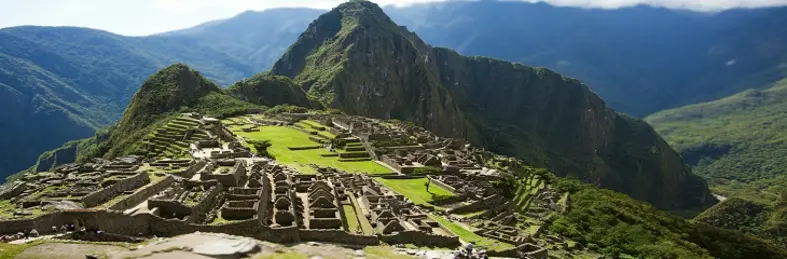
If you like visiting rare, mysterious places around the world and finding out awe-inspiring facts about ancient civilisations then PROMPER?, the Peru?s tourist board?s latest offering, is tailor made for you.
The #Dream, then travel campaign, launched recently with an inspirational video in five different languages, (Spanish, English, French, German and Italian) intends to introduce Peru and its cultural richness to prospective visitors.
Most of the videos available on the YouTube channel of VisitPeru will be shared on various social networking sites, to make information about Peru easily accessible to the world.
The South American country, most famous for the unique architecture of Machu Picchu, built by the Inca people in the 15th century, is the seat of many more civilisations, such as the Caral civilisation, the Paracas society, the Chavin people and the Wari, all of whom were the predecessors of the Incas.
Even nature has bestowed the country with a wide variety of flora and fauna. While on one hand you have the desert and the naturally made desert oasis in Huachachina; not far from the arid land, is the seaside of Paras, with a rich biodiversity. Don?t forget to catch a glimpse of the sea lion, penguin and dolphin at the Paracas National Reserves.
In the southern portion of the Amazonas, populated by rainforests and mountain ranges, lies Kuelap, a walled settlement built by the Chachapoyas in the sixth century. People lived here till the Spanish conquest in 1570; and today, the town of Chachapoyas is also well known for the Gocta waterfalls, discovered in 2006. Although the local residents of Coachimba knew about it, its height (at 2,531feet) and stature as one of the tallest waterfalls in the world came to light only in recent past.
Yet the most striking feature of the country remains the Nazca lines, which has held a place of mystery for most of the people who have seen or heard about it. From an aeroplane, it seems like a simplistic drawing, akin to the scribbling of a child. But from close quarters, it can be seen as a geoglyph, created by digging shallow trenches not more than 10-15 cm in depth, and removing the red-coloured pebbles from the desert floor.
These trenches spread out over several metres in length, in the shape of a bird, animal or even human figures, are seen all over the Nazca desert. Recently, a team of Japanese researchers found 41 more such geoglyphs, dating back to somewhere between 300 BCE-500 BCE.
It is believed that they were created for agricultural purpose, or to mark the appearance of certain constellations in sky. But it is largely conjecture, as studies trying to unravel its specific function, is still underway. However, what surprises many is that, how these geoglyphs have remained intact over the centuries, despite the risk of desert storms or other climatic hazards ruining them.
Once the physical adventures give away, you can also indulge in some authentic gastronomical adventure, which allows you to taste authentic Peruvian cuisines, such as the Solterito De Quinua or Lomo Saltado. If you prefer a quick snack, then choose Solterito De Quinua, which can be made in 10 mins, with quinoa, fava beans, tomatoes, corn, cheese, pepper, olive oil, red onion, parsley, black olive, vinegar and salt, tossed together, with a bit of lime juice for taste.
But Lomo Saltado comprises a meal, for which you have to marinate the strips of sirloin with condiments, such as cumin powder, soy sauce, salt, pepper, garlic paste, vegetable oil and red vinegar; and then stir fry them with tomatoes, onions and a Peruvian chilli pepper, with a bit of parsley and coriander leaves thrown in. It is served with French fries and rice, with a bit of soy sauce for dressing. For a short demo, look up the official YouTube channel of Visit Peru.
Lastly, the connoisseurs of art will also find something for themselves, as the famous fashion photographer, Mario Testino?s works on traditional Peruvian dresses will be accessible for viewers through an online exhibition, Alta Moda. These photographs document the ethnic histories and identities of the wearers, who come from Cusco and its surrounding regions.
For Mario Testino, who was greatly inspired by the work of Martin Chambi, the earliest photographer to document these traditional garments, each detail reveals something about the wearer, his/her family and social status. The colour and accessories used in each of the garments, bears a social or cultural significance, which will be lost with urbanisation. Hence, there arises a need to preserve the couturial heritage through photographs.
Image source:PromPeru.